11/16/23

National Family Health History Day & Your Family Pedigree

This coming Thanksgiving Day is also National Family Health History Day. As you sit down at the Thanksgiving table this year, think of all of your blood relatives -- grandparents, parents, siblings, aunts, uncles, nieces, nephews, and cousins -- whether they occupy a chair at the table or not. 


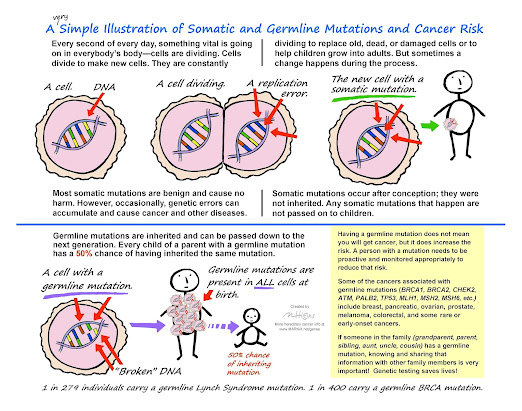
No matter what your emotional relationship is with them, you share a genetic connection with each one – up to 50% of your DNA with some*. And with that genetic link, there might be some genetic health issues, including hereditary cancer.


So, while you are making plans for Thanksgiving this year, make plans to speak up about family health history. It might be difficult finding just the right moment to start the conversation, but having the discussion just might make a huge difference in your health or
the health of one or more of your kin.

Share the details of what you know and encourage your loved ones to share what they know and to be proactive in their own health care. Knowledge is power and it might potentially save a life.

Here’s the link to the Family Health History / Cancer Pedigree
pictured above that you can download and fill out to share when you gather with your relatives. Maybe print copies for your whole family. And if there is any history of chronic disease and/or cancer be sure to share the information with your doctor or a genetic counselor.

And if you know my wife's hereditary cancer story, you will know why I created this pedigree and why I'm so determined as an advocate to get families to share health history openly and honestly.


*See this post to learn more about genetic mutations and cancer:


# NationalFamilyHealthHistoryDay #cancer #FamilialDisease #HereditaryCancer #Genes #GeneticMutations #DNA #Thanksgiving #family #relatives #pedigree #FamilyTree #FamilyPedigree

11/7/23

November is National Family Caregiver Month. An Honest Look at Cancer Caregiving.

For those who may not know it, November is National Family Caregiver Month. It is easily missed. It doesn’t have the hype of Breast Cancer Awareness Month. There are no walks or galas to “celebrate” it. And, even though there are literally tens of millions of family caregivers in the US alone, very few publishers are going to feature an honest treatise on the subject because it’s hard to put a positive spin on it. Caregiving is difficult and absolutely heartbreaking at times; there really isn’t much of a feel-good angle to it. And only rarely is there a happy ending, so most stories are not going to generate many likes and shares.

I was a cancer caregiver, and I wrote this story about caregiving. And I was brutally honest (but not as much as I wanted to be). I’m grateful that The Mighty accepted the story and had the courage to run it.

11/4/23

Stepping Up Once Again to Prevent Cancer

I’m being asked to climb up on my "hereditary cancer awareness and prevention soapbox" and advocate for cancer screening legislation again...

My story at CURE about a hereditary cancer screening bill I initiated in honor of my late wife and the effort it has taken to try and get it passed.


Here's the link to the story: https://www.curetoday.com/view/stepping-up-once-again-to-prevent-cancer


10/2/23

Revisting Thoughts on Breast Cancer Awareness Month

During Breast Cancer Awareness Month last year, I wrote an article and created a cartoon for Cure Today. The response to it really surprised me. https://www.curetoday.com/view/thoughts-on-breast-cancer-awareness-month-the-disease-is-no-stroll-through-the-park-  Titled, “Thoughts on Breast Cancer Awareness Month: the Disease Is No ‘Stroll Through the Park,” it was not a put-down of the cancer survivors, thrivers, previvors, and caregivers who chose to participate in these walks. Rather, it was about the truly awful things and horrific facts about breast cancer you rarely see or hear about at these events. It was the view of Breast Cancer Awareness Month events from my perspective as an exhausted, frightened, and heartbroken caregiver sitting in a cancer treatment center with the love of my life and facing the cruel reality of her stage 4 breast cancer diagnosis.  The story is linked above. The Facebook response is here: https://www.facebook.com/photo/?fbid=543070477825349&set=a.404816141650784During Breast Cancer Awareness Month last year, I wrote an article and created a cartoon for Cure Today. The response to it really surprised me.

Titled, “Thoughts on Breast Cancer Awareness Month: the Disease Is No ‘Stroll Through the Park,” it was not a put-down of the cancer survivors, thrivers, previvors, and caregivers who chose to participate in these walks. Rather, it was about the truly awful things and horrific facts about breast cancer you rarely see or hear about at these events. It was the view of Breast Cancer Awareness Month events from my perspective as an exhausted, frightened, and heartbroken caregiver sitting in a cancer treatment center with the love of my life and facing the cruel reality of her stage 4 breast cancer diagnosis.

The story is here:
https://www.curetoday.com/view/thoughts-on-breast-cancer-awareness-month-the-disease-is-no-stroll-through-the-park-

 
Cure Today's Facebook post is here:
https://www.facebook.com/photo/?fbid=543070477825349&set=a.404816141650784


#BreastCancer #BreastCancerAwarenessMonth #Stage4 #MBC #HereditaryCancer #BRCA2 #PinkRibbon #BreastCancerWalks #MetastaticBreastCancer #chemotherapy


9/27/23

National Previvor Day

Previvor Infographic

Today is National Previvor Day. My daughter is a previvor. My late wife should have been one.
 
For more information about hereditary cancer awareness and prevention, go to www.genetionary.org


9/22/23

We Need to Change the Way We Talk About Hereditary Cancer

It's National Hereditary Cancer Week. It's time to speak up.

I will be brutally honest; my wife died an unbearably horrible death caused by a preventable cancer. Her untimely death happened because too many people, including health care professionals, were incapable of having a serious, mature conversation about a hereditary cancer risk with a family already devastated by several different cancers.

And my late wife is not the only person this has happened to. As an advocate, I have encountered many others whose lives have been devastated by a hereditary cancer diagnosis that could have been prevented.

Things need to change. Nobody should die of a preventable cancer. Nobody!

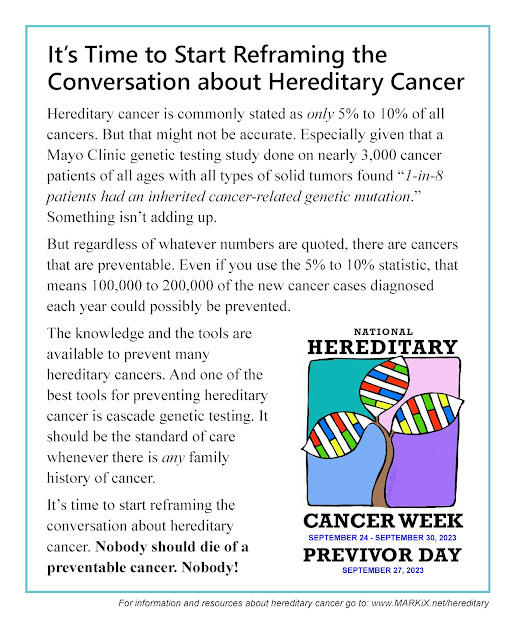
  Hereditary cancer is commonly stated as only 5% to 10% of all cancers. But that might not be accurate. Especially given that a Mayo Clinic genetic testing study done on nearly 3,000 cancer patients of all ages with all types of solid tumors found “1-in-8 patients had an inherited cancer-related genetic mutation.” Something isn’t adding up. But regardless of whatever numbers are quoted, there are cancers that are preventable. Even if you use the 5% to 10% statistic, that means 100,000 to 200,000 of the new cancer cases diagnosed each year could possibly be prevented.  The knowledge and the tools are available to prevent many hereditary cancers. And one of the best tools for preventing hereditary cancer is cascade genetic testing. It should be the standard of care whenever there is any family history of cancer.  It’s time to start reframing the conversation about hereditary cancer. Nobody should die of a preventable cancer. Nobody! 

For more information about hereditary cancer go to : www.markix.net/hereditary