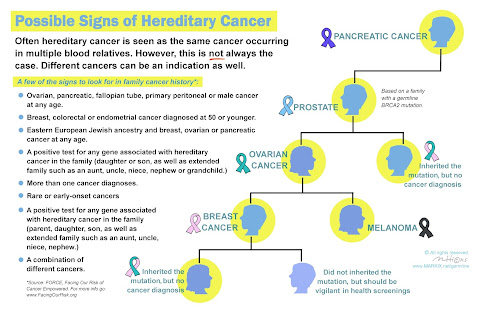
I thought I’d create a visual to help put the statistics in perspective.

You can download a PDF of this graphic at https://genetionary.org/

I thought I’d create a visual to help put the statistics in perspective.


#HereditaryCancer #BRCA2 #KnowledgeIsPower #1FORCECommunity #FacingOurRisk #CancerAdvocate #CancerPrevention #CancerCaregiving #HBOC #previvor #GeneticTesting #HIPP
Cascade Testing is one of the most important tools for breaking the cycle of hereditary cancer in families. It is the testing-sharing-testing-sharing of genetic test results among blood relatives.
Is there a history of cancer in your family? (Grandparents, parents, siblings, aunts, uncles, nieces, nephews, or cousins?) Genetic testing saves lives!
Cascade testing requires two important steps:
1. Having testing done.
2. Sharing information.
That includes sharing test results and the specific mutation in the gene, like 3773delTT in BRCA2. And as soon as the information is known.


I don’t have to imagine this; I
lived this nightmare.
My wife died a horrible death from hereditary cancer.
But her cancer and her untimely death could have been prevented.
The graphic is loosely based on my late wife’s family
pedigree. In her family, the exact same BRCA2 mutation-- let me repeat that --
EXACT SAME BRCA2 MUTATION is shared among 1st, 2nd, 3rd, 4th, 5th, and possibly
6th degree (too young to test) blood relatives. That’s a higher degree of
separation than is shown on the graphic.
As you can see, it was not just an
individual issue; it was a familial issue. Unfortunately, it was not treated as
such, resulting in a very preventable tragedy.
_____________________________________________________
Read my story about this graphic at CureToday.com
Six Degrees of Separation for Cancer Genetics
_____________________________________________________
Having a genetic mutation that increases your risk of
cancer is not that rare.
About 1 in 279 people have a genetic mutation that puts
them at risk of Lynch Syndrome. Colorectal, stomach, ovarian, and pancreatic
cancer, are just some of the cancers associated with the mutations linked to
the syndrome.
About 1 in 400 people have a BRCA1 or BRCA2 mutation
that puts them at risk of Hereditary Breast and Ovarian Cancer Syndrome.
There are more than 50 other hereditary cancer
syndromes.
And the percentage of hereditary cancers may actually
be higher than what is often quoted, as a MAYO study demonstrated: https://medicalxpress.com/news/2020-11-patients-cancer-harbor-inherited-genetic.html
More hereditary cancer information created by me at: www.MARKiX.net/BRCA2
#HereditaryCancer #GermlineMutations #BRCA1 #BRCA2 #LynchSyndrome #HIPPA #PrivacyLaws #HealthCare ##CancerPedigree #DegreesOfSeperation #HBOC #MAYO #KnowledgeIsPower #PreventCancer #GeneticTesting #GeneticTestingSavesLives

Hereditary Cancer Advocacy and Looking into My Genetic Inheritance
#GeneticTestingSavesLives #germline #GermlineMutation #GeneticTesting #previvor #HereditaryCancerSyndromes #HereditaryCancer #GeneticCounseling
#BRCA2 #BRCA1 #CHEK2 #ATM #PALB2 #PTEN #MLH1 #MSH2 #MSH6 #TP53 #KnowledgeIsPower
This is the part that
is often missed when trying to "connect the dots" in hereditary cancer.
Sadly,
this lack of knowledge about how one single germline mutation can cause
different cancers in family members is why genetic testing is often not
recommended for some individuals who may be at risk for hereditary cancer. I know,
because it tragically happened to my late wife.
That's why
sharing family health history, genetic testing, and genetic counseling
are so important. Genetic testing saves lives. Knowledge is power.
For more info about hereditary cancer, go to www.genetinary.org