
Nobody should die of a preventable cancer. Nobody!
The cartoon can also be viewed in a larger format at https://markix.net/brain/

Nobody should die of a preventable cancer. Nobody!
The cartoon can also be viewed in a larger format at https://markix.net/brain/


I celebrate Previvor Day every day, but more so on Father’s Day.
For those unfamiliar with the term, a previvor is someone who has not been diagnosed with cancer but is at a higher risk for cancer due to certain inherited genetic mutations (BRCA1, BRCA2, CHEK2, ATM, PALB2, TP53, MLH1, MSH2, MSH6, etc., etc.). Being a previvor does not mean you will get hereditary cancer; there are ways to reduce the risk. But those choices can be life-altering.
My daughter is a previvor.
Imagine being in your 20s and watching your mother die a horrific death caused by a pathogenic genetic mutation that you had just recently learned that you also carry. Then having to face all the life-changing medical decisions and procedures to reduce your cancer risk without your beloved mother by your side. That takes exceptional courage.
Genomic science has given my child, who has grown into a kind, creative, and confident scientist, a chance to live a full life cancer-free, something her mother did not get. Because of laws and attitudes still stuck in the last century, information that would have saved her mother’s life did not get shared.
Father’s Day gives me another opportunity to advocate for hereditary cancer awareness and prevention. And prevention starts with knowing and sharing family health/cancer history — both maternal AND paternal.
Everyone has tumor suppressor genes like BRCA (BReast CAncer) 1 and 2. Mutations in those and other genes can cause many different cancers. And knowing that genetic mutations can be passed down for generations from fathers as well as mothers can be life-saving.
Happy Father’s Day to all the fathers of previvors.
Life is fragile. Knowledge is power.

 I had a successful career in the arts long before a pathogenic germline mutation changed everything. So, for a little break from my hereditary cancer advocacy infographics that I've been posting here for the past few years, here’s a look at some of my Testudines illustrations for today.
The top left image was my first children's magazine cover, done as a 20-something just beginning my freelance illustration career. (Back in the days when getting a gig from an editor or art director a couple thousand miles away involved either a long-distance phone call or a snail mail letter. And when someone liked your work, you got fan mail!)
If you want to color a picture today, you can go here to download the Sulcata Tortoise coloring page.
Or here to download the Desert Tortoise coloring page.
The How to Draw a Turtle page is here.
The sleeping tortoises are from the children’s book, Coyote Claus: A Southwest Desert Tale, published by Sunbelt Publications. (BTW, I donate ALL royalties from the sales of the Coyote Claus book to help the hereditary cancer community fight cancer.)
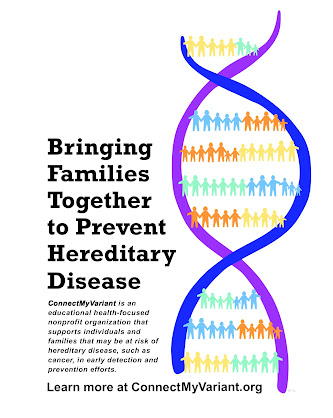
Knowing and sharing family health history can be life-saving. The same genetic variant that may increase the risk of cancer or heart disease can be shared with grandparents, parents, brothers, sisters, aunts, uncles, and cousins — even cousins several times removed.
Art created by me as a volunteer advocate for the ConnectMyVariant May newsletter.

Maybe we need to look at preventing and curing cancer differently. Let’s start by being honest about cancer.

It's fitting that genealogy should begin with “gene,” because it is genes that truly connect families. Distant genetic relatives may have more in common with you than just a shared ancestor, and that knowledge may help prevent cancer and other diseases. Finding your roots and branching out can be enlightening and sometimes life-saving.
Learn more at www.ConnectMyVariant.org
(Created for CMV as a volunteer hereditary cancer awareness and prevention advocate.)